Military Justice Debate: Why Restoring Military Courts May Not Solve Service Members' Issues
Legal experts at the Pryntsyp center have evaluated proposals to rebuild Ukraine's military justice system. Analysts warn of severe risks to judicial independence and advocate for specialized civilian judges instead.
 🎓Education
Photo: Ukrainska Pravda
Key points
- Human rights center 'Pryntsyp' cautions against recreating separate military courts.
- Assigning military ranks to judges risks compromising judicial independence under command pressure.
- Specialization of civilian judges is recommended as a fair, European-standard alternative.
Debates continue in Ukraine regarding the potential restoration of specialized military courts and prosecutors, which were abolished back in 2010. Relevant proposals are currently being processed by a Temporary Special Commission of the Verkhovna Rada. However, analysts from the human rights center 'Pryntsyp' point out that returning a military hierarchy to the judiciary will not resolve key issues faced by service members and may instead introduce risks of command pressure.
Proponents of military courts argue that judges require combat experience and a deep understanding of military life. Human rights experts counter that granting military ranks to judges automatically subjects them to military discipline, command authority, and military regulations. This opens pathways for direct interference by the Ministry of Defense or General Staff in judicial decisions, as these entities influence ranks and career progression.
Alternative Solutions for Protecting Soldiers' Rights
Instead of recreating a separate military court system, 'Pryntsyp' experts propose establishing specializations for civilian judges handling cases related to military offenses. This approach aligns with Opinion No. 15 of the Consultative Council of European Judges, which highlights that specialized expertise enhances the quality of rulings without compromising judicial independence.
Experience gained during the full-scale war demonstrates that civilian courts have already accumulated significant jurisprudence in military matters. When complex operational details arise, judges can engage qualified experts, whereas military ranks alone do not guarantee impartiality or superior legal knowledge.
Additionally, analysts point to recent legislative trends. For instance, draft law No. 8271 was enacted in 2022 to increase penalties for unauthorized absence and disobedience, while draft law No. 13452 was debated in 2025. Both initiatives targeted subordinate accountability rather than command abuses, underscoring the risk of leaning judicial systems too heavily toward command interest.
Source Ukrainska Pravda — pravda.com.ua/news/2026/11/20/8063800/ ↗
Read next
 🚨Events
Criminal and Environmental Incidents in the Rivne Region: A News Overview
The Rivne region has faced a series of high-profile incidents, including a serious crime in the Dubno district, land corruption schemes, and environmental violations.
 🇺🇦Ukraine
Trump Administration Issues Ultimatum for Peace Deal with Russia by January
The White House is pushing for a rapid end to the war before the new US Congress takes office, sparking concerns in Kyiv and Europe.
 🇺🇦Ukraine
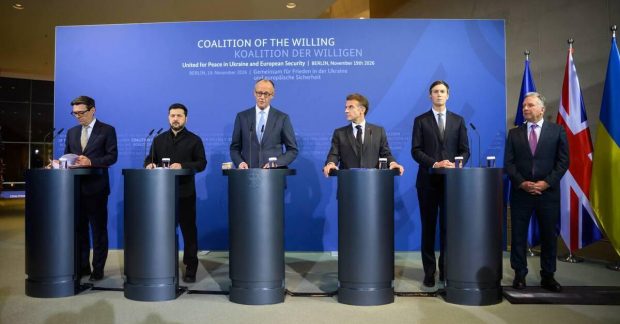
European leaders consider conditions for participating in talks with Moscow regarding Ukraine
European diplomats are prepared to engage with Russia provided they are granted a full role in the negotiation process, while the Kremlin rejects any NATO-style security …
 🏛️Politics
Donald Trump claims Putin is willing to end the war through diplomacy
US President Donald Trump reported on a meeting with Vladimir Putin in China, where they discussed the prospects for ending the Russia-Ukraine conflict.
 🏛️Politics
Denmark to expel Russian military attaché
The Danish Ministry of Foreign Affairs has announced plans to expel the Russian military attaché in response to hostile intelligence activities.
 🏛️Politics
Estonia to close border with Russia and summons diplomat over attacks on Ukraine
The Estonian government has decided to close all road border crossing points with Russia starting December 1 in response to ongoing aggression against Ukraine.